
Materials 6 min read
PLA, PETG or ABS: which material for your product
Three materials cover nearly all the 3D printed products sold online. The choice is not made on a data sheet, but on what your customer will do with the object: where they put it, at what temperature, with what impacts. Here is how to decide without spending the week on it.
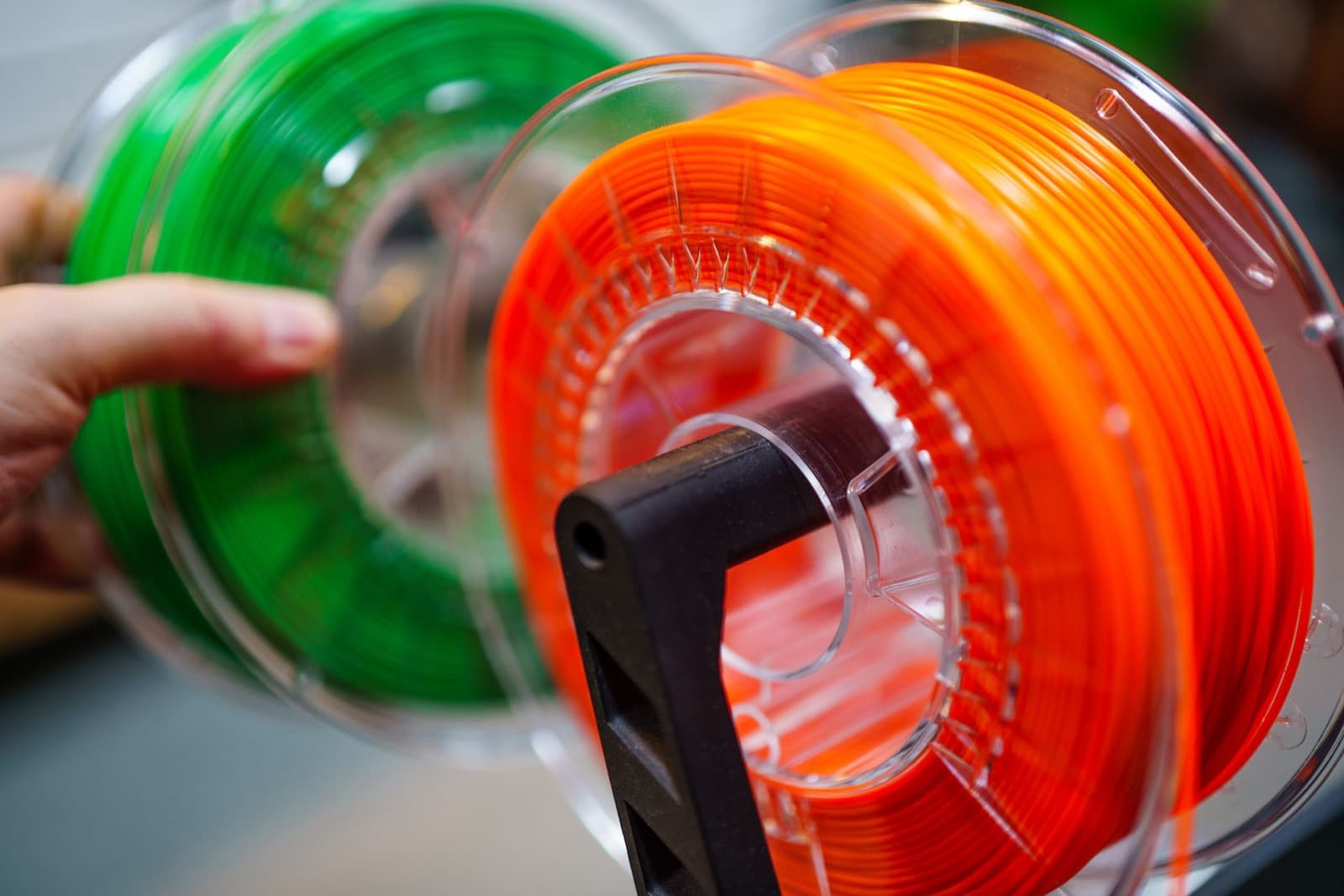
Choose the material for its use, not its data sheet
The first question is never "what is the best material", but "where does the object end up". A bedside lamp and an accessory that stays in a car all summer do not face the same constraints: the material that suits the first one warps in the second.
Ask yourself three questions before looking at prices. Is the object exposed to heat? Does it take impacts or twisting? Does it spend time outdoors or near water? The answers usually rule out two options out of three.
Also keep in mind that a customer return costs more than a few cents of material. The detailed calculation is in our article on the price of a printed part.
PLA: the default choice for indoor use
PLA is the easiest material to print, and it produces the most consistent parts. It is rigid, stable over time, and takes either a matte or a satin finish depending on the finish chosen. For decor, desk items, displays or lamp parts, it is the logical starting point.
Its limit is well known and must be respected: PLA starts to deform around 50 to 60 °C. That is not a problem in a living room, but it becomes one on a car dashboard, behind a window in full sun or near a heat source. In those cases, switch to PETG or ABS.
It is also the cheapest material by volume, at €0.033/cm³ with us. On a decor catalog, that shows up directly in your margin.
- Decor, desk items, figurines, displays
- Lamp parts that do not touch the hot socket
- Prototypes and test runs before a launch
PETG: when the product leaves the house
PETG is slightly more flexible than PLA and handles impacts much better. A thin part that would snap cleanly in PLA tends to bend before breaking in PETG. It also handles heat and humidity better, which makes it the go-to material for kitchens and sheltered outdoor use.
In practice: a hook that carries weight, a holder that lives in a bathroom, a planter accessory under an awning, a part that will be screwed in and therefore put under stress. The price difference is small, at €0.038/cm³, and it buys peace of mind on after-sales service.
The finish is slightly glossier than PLA, with layers sometimes a little more visible. That is not a defect, it is a different look that you need to account for when taking photos.
ABS: heat, impacts and a technical look
ABS resists both heat and impacts, with a comfortable margin on both. It is the material to pick when the part has a real mechanical function or will regularly live in a hot environment.
The finish is more technical, closer to an industrial plastic part than to a decorative object. For some products that is exactly what you want, for others it clashes with the catalog photo. At €0.040/cm³, it is also the most expensive of the three, although the gap stays small on a small part.
Visual finish matters as much as strength
A product sold online is seen in a photo first. Layer lines, the way light catches the surface, the depth of a matte color: all of this changes with the material and with the orientation of the part during printing.
Matte PLA is very forgiving: it breaks up reflections and hides the layers. PETG reflects more light and needs careful lighting. ABS gives a more understated look, close to injection molded plastic.
The orientation of the part is decided when the file is prepared, and it affects the final result as much as the material does. The topic is covered in detail in preparing a print-ready STL file.
Food contact: validated case by case
This is the point where nothing should be promised lightly. Food contact does not depend only on the material: it also depends on the process, the surface finish, the actual use and the cleaning the object will go through.
If your product touches food, do not advertise it on your product page before asking. Describe the intended use precisely in your request and we validate case by case before starting production. A kitchen item that touches nothing, such as a holder or a storage piece, does not raise this issue.
Cost per cm³ and its effect on your margin
The production price is made up of €0.50 of preparation per part, plus material for the volume actually printed. The difference between PLA and ABS is €0.007/cm³, a few cents on a typical part: it is almost never what decides.
What moves the price is the volume of material. A hollowed-out part with well-sized walls costs much less than a solid block, whatever the material. The geometry is what you should work on, not the choice of filament.
Quantity discounts then apply: -3% from 10 parts, -6% from 50, -10% from 200. The full details are on the pricing page, and you can try your own volumes in the simulator.
- PLA: €0.033/cm³
- PETG: €0.038/cm³
- ABS: €0.040/cm³
How to decide in practice
Start with PLA. If the object sees heat, humidity or impacts, move to PETG. If it also has a mechanical function or lives in a constantly hot environment, go with ABS. This rule covers the vast majority of catalogs sold online.
When in doubt, order a single part in two materials before launching the run: there is no minimum order. Allow 7 business days for standard, 3 days for express with a 30% surcharge.
To send your file and choose the material, everything happens on the production page. If you would rather start from a product that is already designed and tested, look at the ready-to-sell models.
Frequently asked questions
- What is the difference between PLA and PETG for a product sold online?
- PLA is more rigid, cheaper and gives a very clean matte finish, but it deforms around 50 to 60 °C. PETG is slightly more flexible, handles impacts better and withstands heat and humidity better. For indoor decor, PLA is enough; as soon as the object leaves the house or goes into the kitchen, PETG is safer.
- Does PLA withstand the heat inside a car?
- No, and it is the most common mistake. PLA starts to deform around 50 to 60 °C, a temperature easily reached inside a car in summer or behind a window in full sun. For a car accessory, choose PETG or ABS.
- Can you print an object that comes into contact with food?
- It is not decided on the material alone: the process, the surface finish and the actual use matter just as much. Describe the intended use precisely in your request, and we validate case by case before starting production. Until that validation is done, do not advertise it on your product page.
- Which material is the cheapest for 3D printing?
- PLA, at €0.033/cm³, compared with €0.038 for PETG and €0.040 for ABS, with €0.50 of preparation per part in every case. The gap between materials stays small on a typical part: the volume of material printed weighs most on the price.
- Can you order a single part to test a material?
- Yes, there is no minimum order and no subscription. Ordering the same part in two materials before launching a run is often the fastest way to decide, especially when the visual finish comes into play.