
ProductionBy The Bobitech Cloud3D team 4 min read
Infill and layer height: what they change in the price
Two settings make the same 3D printed part vary: infill, which decides what is inside, and layer height, which decides how fine the surface is. They change strength, finish, print time and therefore price. Here is what each one brings, with figures from our reference bedside lamp.
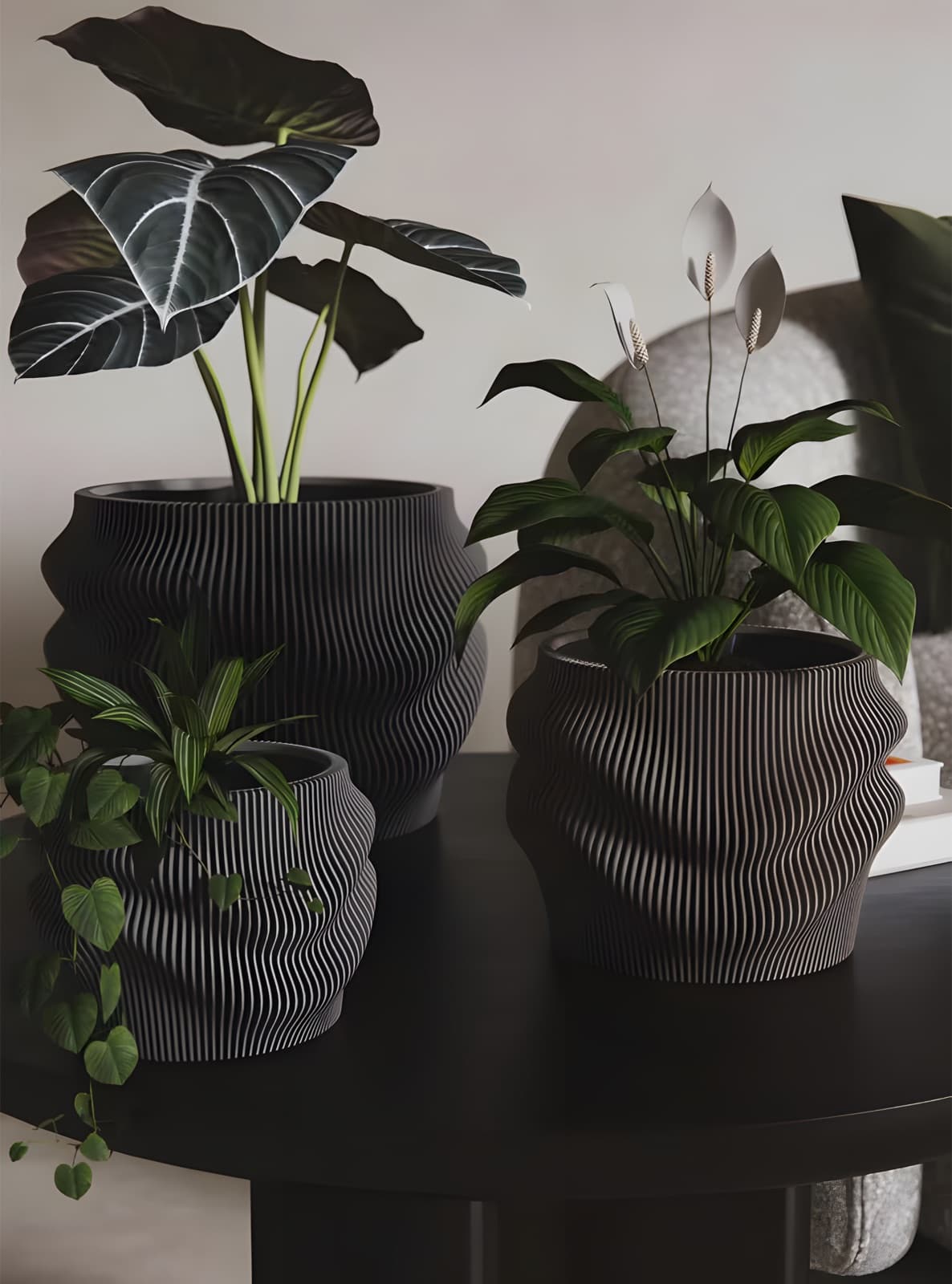
What is inside a printed part
A 3D printed part is almost never solid. The printer first draws a shell: walls, a top and a bottom, solid and about 1 mm thick. The inside is then filled with a more or less dense pattern, expressed as a percentage: this is the infill.
The part is built layer by layer, from the bottom up. The thickness of each layer is the layer height, also called print quality. It is measured in millimeters: 0.12 mm, for example, is 120 microns.
Our price calculation follows the same logic: the material counted is that of the shell plus the inside at the chosen infill, and machine time depends on both settings. The full principle is in how the price of a part is calculated.
The four infill levels
Infill is chosen when you order, from four levels. It changes both the amount of material and the print time, so it has a direct effect on the price.
On our reference bedside lamp, in PLA and standard quality, the unit price ranges from €14.22 with light infill to €18.24 when solid. Standard infill, the default setting, gives €14.64.
- Light, 10%: €14.22 per lamp, for decorative objects that carry nothing
- Standard, 20%: €14.64 per lamp, the default setting
- Reinforced, 50%: €16.02 per lamp, for parts under load
- Solid, 100%: €18.24 per lamp, for parts under heavy stress
Which infill for which object
For a decorative object, a pot cover, a vase, a lamp or a figurine, the shell does most of the work. Standard infill is enough, and light infill suits parts that take neither impact nor load. Going from standard to light takes €0.42 off the lamp.
For a part that carries weight, is screwed in or clips on, such as a hook, a holder or a fastener, reinforced infill adds strength. It adds €1.38 to the lamp compared with standard. Solid infill, which adds €3.60, is for parts that must withstand a heavy load.
Infill cannot be seen from the outside: it changes nothing in how a part looks. Choosing more than needed raises the price without giving the buyer anything.
The three layer heights
Layer height comes in three levels: fine (0.12 mm), standard (0.20 mm), the default setting, and draft (0.28 mm). It does not change the amount of material, only machine time: the thinner the layers, the more of them it takes to reach the same height.
On the reference lamp, in PLA with standard infill, that gives €15.99 in fine, €14.64 in standard and €14.07 in draft. Fine quality adds €1.35 to standard, draft takes off €0.57.
- Fine, 0.12 mm: €15.99 per lamp
- Standard, 0.20 mm: €14.64 per lamp
- Draft, 0.28 mm: €14.07 per lamp
Which quality for which finish
Layers show on curved and sloped surfaces, as thin horizontal lines. The thinner the layer, the less visible these lines are. Fine quality is worth it for a figurine, an object held in the hand or a part photographed up close, where detail matters.
Standard quality suits most objects sold in online shops: the finish stays clean and the print time reasonable. Draft is for functional parts, hidden brackets or prototypes, where looks come after price.
A part with straight, vertical shapes shows its layers very little: fine quality adds little there. A rounded shape, such as a lampshade or a curved pot cover, benefits more.
Combining the two settings
The two settings are independent. A decorative part on display can be ordered with light infill and fine quality; a hidden bracket, with reinforced infill and draft quality. The right choice starts from how the object is used, not from the highest setting.
To compare before ordering, the simulator shows the price of your file with the infill and print quality of your choice, and the pricing page details the rate card. The choice of material, which also affects strength, is covered in PLA, PETG or ABS.
Frequently asked questions
- Which infill should I choose for a 3D print?
- Standard infill, 20%, suits most objects. Light, 10%, is enough for a decorative part that carries nothing; reinforced, 50%, and solid, 100%, are for parts under load. On our reference lamp, the price ranges from €14.22 with light infill to €18.24 when solid.
- Does layer height change the amount of material?
- No. Layer height only changes machine time, and therefore the price: €15.99 in fine (0.12 mm), €14.64 in standard (0.20 mm) and €14.07 in draft (0.28 mm) for the reference lamp. The material depends on the infill and the shape.
- How much is 0.12 mm in microns?
- 0.12 mm is 120 microns. This is fine quality, which makes layers less visible on curved surfaces, at the cost of a longer print time.
- Can infill be seen on the finished part?
- No, it is enclosed in the shell of the part, solid walls about 1 mm thick. It changes strength and weight, not the outside appearance. Layer height is what affects the surface finish.