
Production 6 min read
3D printing or injection molding: when to make the switch
3D printing lets you launch a product without spending a single euro on tooling. Injection molding requires a mold, but it brings the price per part down sharply once volumes are there. The real question is not which one is better, but at what point your product should switch sides.
Two processes, two cost structures
With 3D printing, the total price is roughly proportional to the number of parts: €0.50 of preparation per part plus material by volume, with quantity discounts (-3% from 10 parts, -6% from 50, -10% from 200). Nothing is spent before the order.
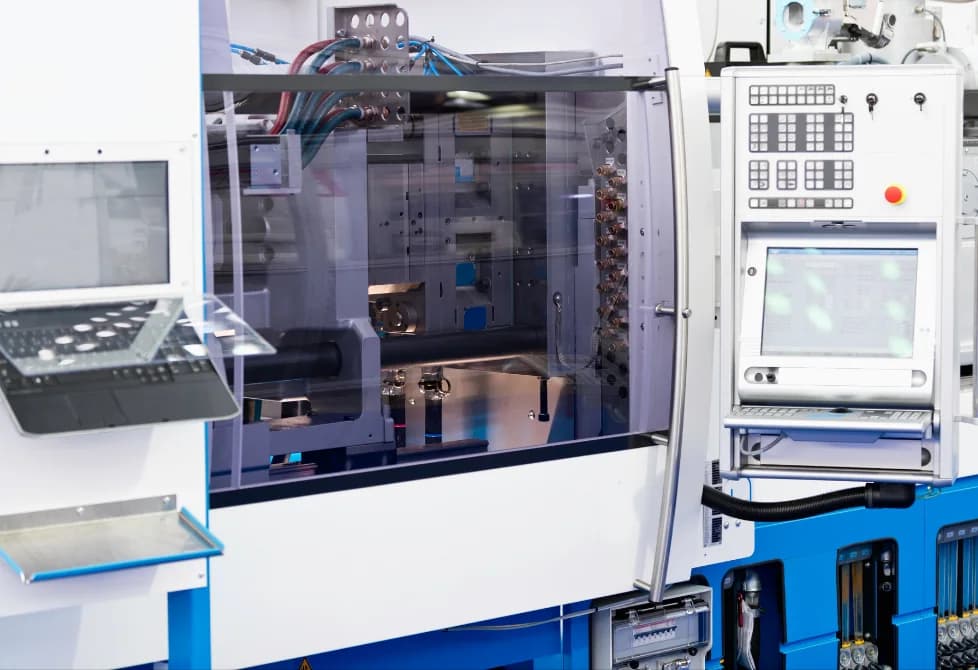
With injection molding, the logic is reversed. You first need a steel mold, which is a fixed cost paid only once. After that, each part comes out in a few dozen seconds and its unit price becomes very low. The more you produce, the more the cost of the mold is spread out.
The decision therefore comes down to comparing a fixed cost to pay off against a constant price per part. Everything else is method for working out when the first curve drops below the second.
Paying off tooling: the calculation to make
The reasoning is always the same. On one side, the unit price in 3D printing for the volume you actually sell. On the other, the unit price in injection molding plus the cost of the mold divided by the number of parts expected over the life of the product.
The break-even point is therefore not a universal quantity. It depends on the size of the part, its complexity, the material and the cost of the tooling. A small simple part and a large complex part do not switch at the same point, and no figure can be given without seeing the product.
Run this calculation on your margin, not on your revenue. The full method is in calculating the margin on a 3D printed product, and you can price the printing side in the simulator.
The three criteria that trigger the switch
Total quantity alone is not enough to decide. Three criteria matter together, and you need all three for a mold to be a good investment.
First, rate: how many parts per month, on a sustained basis. A single sales spike does not justify tooling. Next, consistency: steady sales let you pay off the mold calmly, while erratic sales turn it into tied-up capital. Finally, product lifespan: a mold only pays for itself if the product stays in the catalog long enough, with no planned design change.
If even one of these three points is uncertain, stay with 3D printing. The cost per part is higher, but you keep the freedom to modify, stop or replace the product overnight, without tying up capital.
- Rate: a sustained monthly volume, not an isolated spike
- Consistency: stable sales over several months
- Lifespan: a frozen design that stays in the catalog
What injection molding demands from the part design
A file designed for 3D printing does not go to injection molding as is. The part has to be able to come out of the mold, which requires draft angles on every face perpendicular to the parting line. Without draft, the part gets stuck or scratched on ejection.
You also need uniform wall thickness. A thick area next to a thin wall cools more slowly, shrinks more, and leaves a visible sink mark on the surface or warps the part. Where 3D printing accepts almost any geometry, injection molding requires an even distribution of material.
This redesign work is done upfront, with the mold maker.
- Draft angles on faces perpendicular to the parting line
- Uniform wall thickness across the whole part
- Undercuts, gate locations and parting line to position
Mold lead time
Tooling has to be designed, machined, tested and corrected. This is not a matter of a few days: between design approval and the first compliant parts, the manufacturing time is in a different league from the 7 business days of a 3D printing order.
While the mold is being made, you still have to deliver to your customers: 3D printing then serves as bridge production, exactly as before the launch.
This is also why it is better to launch a mold on a frozen design. A change after machining costs time and money, whereas the same change in 3D printing means replacing a file.
Validate the product with 3D printing before investing
The most concrete benefit of 3D printing is not the price, it is the risk avoided. You launch a product without tooling, you actually sell it, you measure the return rate, the reviews, the comments on strength or size. You fix things, you relaunch.
This phase gives you the missing information to decide on a mold: real volume, seasonality, design flaws nobody had noticed, and sometimes the fact that the product does not sell.
Material choice also matters in this validation, since it shapes the strength the customer perceives: see PLA, PETG or ABS. If you want to start with products that have already been tested, look at the ready-to-sell models.
Moving from one to the other with the same supplier
Bobitech Cloud3D is a service of Bobitech, a plastics manufacturer of about 150 people based in the Plastics Vallée, in Oyonnax, France. Plastic injection molding is our original trade, and on-demand 3D printing extends it to small runs.
In practice, you do not have to change contacts when your product takes off. The same workshop that prints your first parts can study the move to injection molding, rework the design to fit the mold constraints and then take over production. Manufacturing and inspection stay in France.
In the meantime, nothing commits you: no subscription, no minimum order, everything is per order. Production prices are detailed on the pricing page.
How to decide, in practice
As long as your sales are irregular, the design is still changing or you are testing several variants, stay with 3D printing. You pay more per part, but you pay nothing when you do not sell, and you can change products without losing anything.
When the same product has been selling at a sustained, steady pace for several months, the design is frozen and you can see at least a year of life ahead of it, run the payback calculation with the real figures you have gathered. That is when the question of a mold becomes serious.
To launch 3D printed production or have a move to injection molding studied, everything starts from the production page.
Frequently asked questions
- At how many parts should you switch to plastic injection molding?
- There is no universal threshold: it depends on the size of the part, its complexity, the material and the cost of the corresponding tooling. The method is to compare the unit price in 3D printing with the unit price in injection molding plus the cost of the mold divided by the number of parts expected over the life of the product. This calculation can only be done seriously with your product in front of us.
- What is the cost difference between 3D printing and injection molding?
- 3D printing has no fixed cost: you pay for preparation and material on each part, with nothing committed upfront. Injection molding requires a mold paid once, then a very low price per part. One costs more per unit, the other ties up capital before the first sale.
- Can the same 3D file be used for injection molding?
- Rarely as is. Injection molding requires draft angles so the part can come out of the mold, and uniform thickness to avoid sink marks and warping. The design has to be reworked upfront with the mold maker, which we do in-house since injection molding is our original trade.
- How long does it take to make an injection mold?
- A mold has to be designed, machined, tested and corrected: the lead time is in a different league from the 7 business days of a 3D printing order. During that period, 3D printing serves as bridge production so you can keep delivering to your customers.
- Should you test your product with 3D printing before making a mold?
- It is the safest approach. Selling with 3D printing first gives you the real volume, seasonality, customer feedback and the design flaws nobody had anticipated. A mold launched before this validation is a fixed cost committed to a product you know nothing about.